

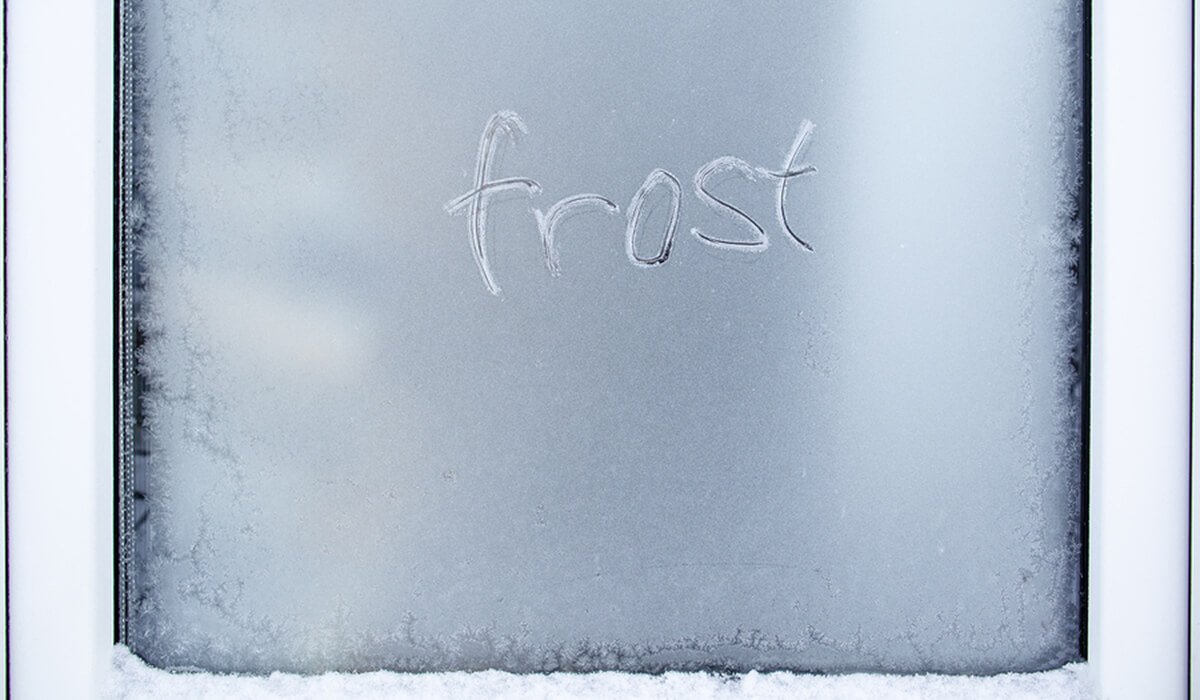
Document the frost as a condition with time, weather, humidity, location, and material effects. Avoid declaring a failed window from one photograph; record evidence that separates indoor moisture, cold-surface geometry, air leakage, and between-pane seal failure.
Alongside the specific checks in Frost on Inside of Windows During a Home Inspection: What to Document, review ice forming on windows and compare that guidance with measured conditions in this home.
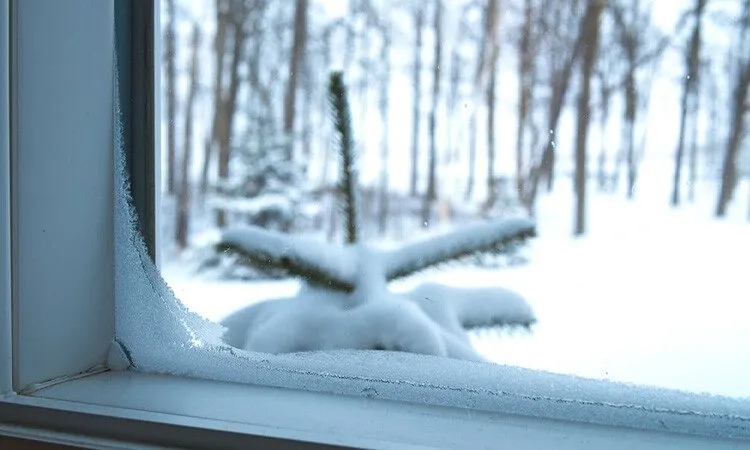
Why the frost pattern matters
Treat the first cold morning as evidence collection, not a verdict. Frost does not begin with the same variable in every home. Outdoor temperature sets the thermal load; glazing, frame, spacer, air leakage, coverings, room heat, and installation shape the interior surface temperature; occupants and ventilation set the moisture load. Diagnosis means keeping those groups separate long enough to test them.
Relative humidity can be healthy in a general sense and still be too high for a cold window on a particular night. Health Canada gives a broad 30-to-50-percent range but advises lowering humidity if condensation appears in cold weather. Natural Resources Canada’s examples show why the acceptable ceiling changes with outdoor temperature and window efficiency.
Evidence to collect:
- Room-side crystals that can be touched.
- Haze sealed between panes.
- Staining or softened trim below the unit.
- Frost tracking an operable joint or perimeter gap.
Within the diagnostic path for Frost on Inside of Windows During a Home Inspection: What to Document, use location and timing to distinguish window ice troubleshooting from between-pane moisture, uncontrolled air leakage, or a room-specific airflow problem.
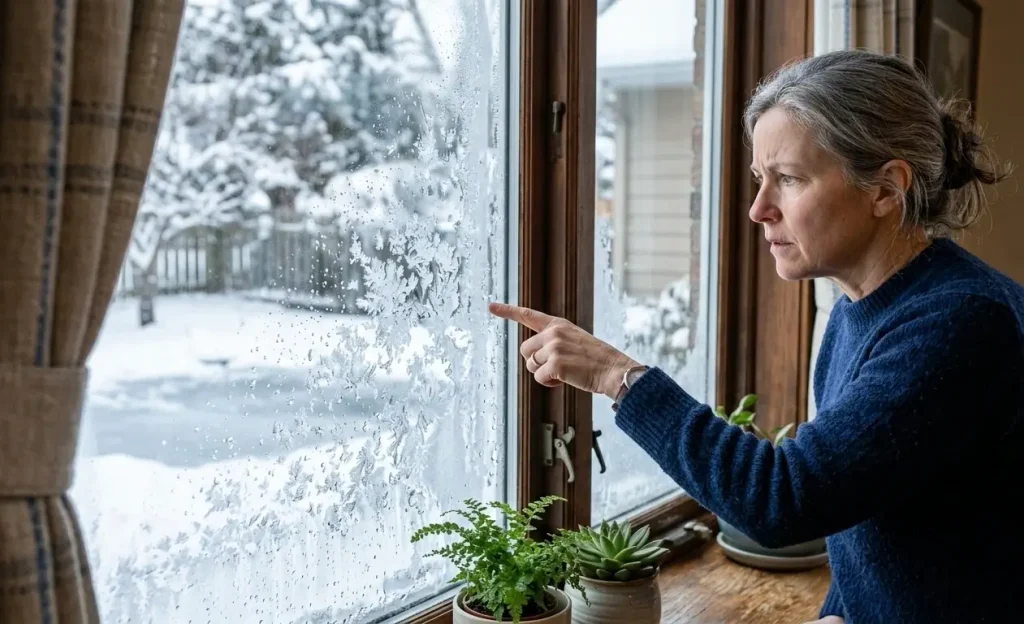
Practical response
- Photograph wide room context and close details.
- Measure indoor temperature and relative humidity.
- Note outdoor temperature, wind, and recent moisture activities.
- Compare matching windows and adjacent rooms.
- State limits where finishes or cavities are not visible.
Illustrative scenario
Illustrative scenario: one kitchen casement has room-side frost after cooking, while a nearby fixed unit is clear. The range hood is off and the casement lock does not fully engage. The report should preserve both possibilities – moisture source and local sash condition – instead of selecting one without testing.
What not to assume
Do not label every dark mark as mould or every frosted edge as a manufacturing defect. Inspection language should describe observed conditions, likely mechanisms, limitations, and appropriate next steps without overstating certainty.
When professional help makes sense
Recommend specialist review when there is concealed moisture risk, active air leakage, damaged framing, repeated between-pane fogging, extensive visible mould, or a need for intrusive testing outside the inspection scope. For a review centred on Frost on Inside of Windows During a Home Inspection: What to Document, bring photos and measurements plus the reference steps for preventing ice on the inside of windows; the visit can then begin with evidence rather than a generic replacement assumption.

Frequently asked questions
Is a hygrometer reading enough?
No. It is one data point. Pair it with surface pattern, room temperature, weather, airflow, operation, and material condition.
Should an inspector scrape off frost?
Only if safe and within the agreed scope. Photographs before disturbance are valuable, and hot water should not be used.
How should uncertainty be written?
Name the observations, explain plausible mechanisms, state what was not verified, and recommend the next qualified review or monitoring step.
Suggested internal links
Sealing Window Gaps for Winter
Mold and Moisture: Hidden Dangers in Your Home
Authoritative sources
Natural Resources Canada – Ratings and certification
Natural Resources Canada – Condensation
Natural Resources Canada – Keeping the Heat In, Section 9